Carignan grape variety

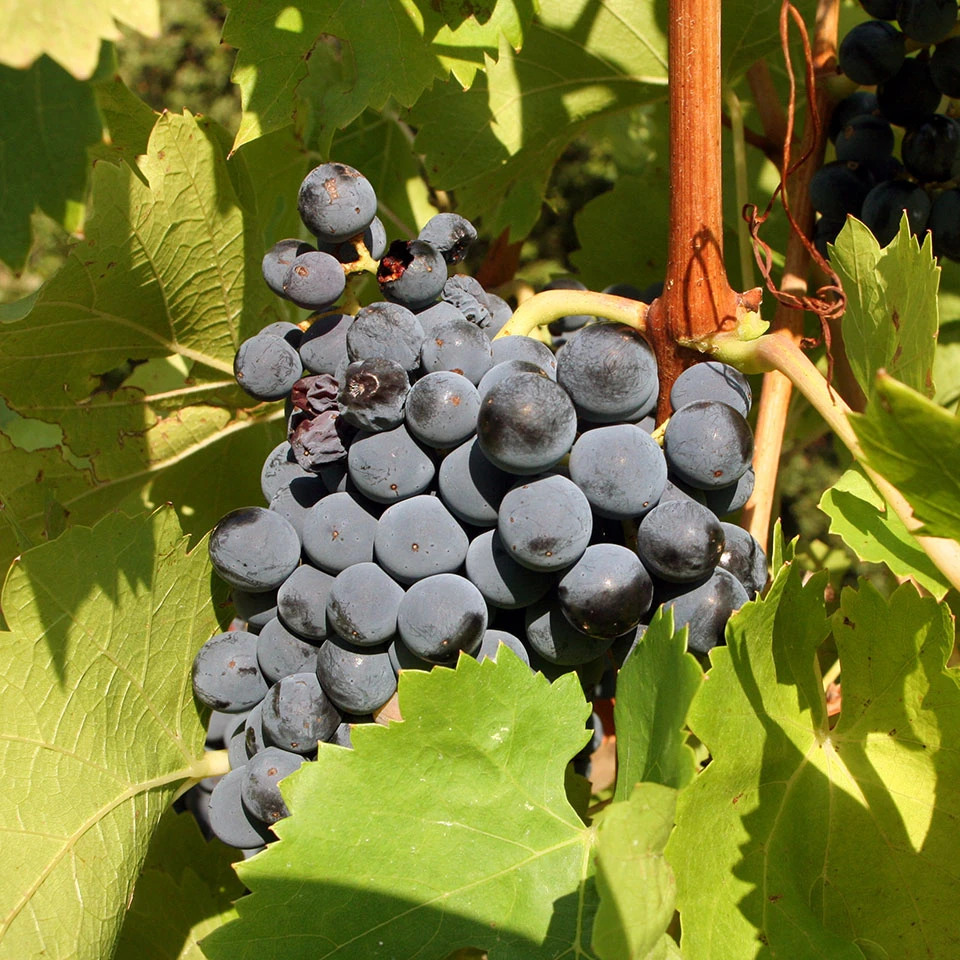
Carignan originally comes from Spain - but is now mainly at home in the neighbouring south of France, Languedoc-Roussillon. A deep dark colour, strong tannins and high acidity are its hallmarks. Aromas of dark fruit, such as plum and cherry, dominate the flavour profile, complemented by notes of pepper, spices and liquorice. Carignan is usually blended with other grape varieties, such as Grenache, Syrah or Mourvèdre, in order to improve the tannin structure of the wines. More recently, single-varietal Carignan wines have become increasingly popular. It is now necessary to limit the yield of this variety, which sometimes tends to produce excessive quantities.
Frequently asked questions (FAQ) about Carignan wine

What does a typical wine made from the Carignan grape taste like?

Carignan is known for its dark, spicy profile. On the nose, you will often find intense aromas of black cherries, blackberries and plums, coupled with a distinctive note of wild herbs (the famous garrigue of southern France), liquorice and sometimes a hint of smoked meat or leather.

What is the structure of Carignan in terms of tannins and acidity?

Carignan is not for the faint-hearted! The grape variety naturally has a lot of acidity and strong tannins (tannins). This gives the wine a very stable structure and a lot of freshness. So that the wine does not appear too "rustic", winegrowers often use the method of macération carbonique (carbonic acid mixing) to emphasise the fruit and soften the tannins.

Are there also lighter versions of Carignan?

Yes, absolutely. While pure Carignan is often very powerful, it is often used in cuvées (blends). It provides the colour and structure, while partners such as Grenache provide softness. However, there are also wonderful Carignan rosés that impress with their lively acidity and raspberry flavours.

Where does the Carignan grape originally come from?

Although today it is usually associated with the south of France, the variety originally comes from Spain, more precisely from the region of Aragon (near the city of Cariñena). There it is often called Mazuelo or Cariñena.

What is the perfect food pairing for a Carignan?

Due to its spicy nature and good acidity, Carignan can handle strong flavours. It is an ingenious accompaniment to braised lamb with rosemary, game dishes or a classic duck confit. Vegetarians should try it with dishes with roasted aubergines, mushrooms or hearty lentil stews.

How does Carignan differ from Grenache?

Think of Grenache as the "charming flatterer" (lots of alcohol, soft texture, red fruit) and Carignan as the "individualist with a strong character". Carignan has significantly more tannin, more acidity and a darker colour than Grenache. They therefore complement each other perfectly in a classic Rhône cuvée.

What is the ideal drinking temperature for Carignan?

It is best to serve a red Carignan at 16 to 18 degrees. If it is too warm, the alcohol will dominate; if it is too cold, the tannins will appear hard and brittle.

Discover more grape varieties for red wines.

Grenache

Grenache is a red grape variety grown mainly in southern France and Spain (where it is known as Garnacha). The wines are typically medium to full-bodied, with low tannins and high acidity.

Read more

Montepulciano

Montepulciano is a red grape variety that is mainly grown in central Italy. Its wines are full-bodied, rich in extract, with strong alcohol and moderate acidity. They typically show flavours of dark fruits such as plums and cherries, often complemented by spicy or tobacco notes.

Read more

Saperavi

Saperavi means "dyer" - and it is indeed one of the few red wine varieties whose skin and flesh are coloured. This explains the almost inky black colour and the intense personality of its wines.

Read more

Zweigelt

Zweigelt is a highly successful new red variety from Austria, whose parents are Blaufränkisch and St. Laurent. It produces violet/red wines with a deep colour and intense aromas such as cherry, red and blackcurrant or blackberry, as well as spicy notes such as vanilla or cinnamon.

Read more

Carmenère

Carmenère gilt als die "Signature Grape" Chiles. Fast die Hälfte der weltweiten Bestände wachsen dort. Ursprünglich stammt die Sorte aber aus Bordeaux, wo vor der Reblauskatastrophe weit verbreitet war. 

Read more

Barbera

Barbera is the most widely cultivated red grape variety in the northern Italian region of Piedmont - but is also widespread in Lombardy and Emilia-Romagna. It produces fruity, accessible red wines with an intense ruby red colour and aromas of red fruits, cherries, plums and spices. They are medium-bodied on the palate, with moderate tannins and lively acidity even when fully ripe.

Read more

Discover more grape varieties for white wines.

Chasselas

Chasselas is a white grape variety that is mainly cultivated in Switzerland, particularly in the Vaud region. It is also found in France and in Germany and Austria under the name Chasselas.

Read more

Chardonnay

Chardonnay is the most widely cultivated white premium grape variety. Its origins probably lie in Burgundy, but today it is grown all over the world. One of the reasons for its success is its enormous ability to adapt to a wide range of conditions.

Read more

Müller-Thurgau)

Müller-Thurgau is a white variety that is mainly cultivated in Germany and Austria. The wines are light to medium-bodied, with moderate acidity and a strong flavour, usually with a typical muscat tone. Müller-Thurgau wines are usually dry or semi-dry and vinified in steel tanks.

Read more

Riesling

Riesling is one of the best-known white grape varieties and is cultivated all over the world - first and foremost in Germany, of course. It is more flexible and versatile than almost any other grape.

Read more

Weißburgunder

The Pinot Blanc grape - called Pinot Blanc in France and Pinot Bianco in Italy - is the lightest-coloured member of the large Burgundy family. The variety produces fresh, fruity wines whose acidity can vary from moderate to strong depending on the style and which develop delicate fruit flavours such as apples, pears or citrus fruits, often complemented by nutty notes such as almonds.

Read more

Airén

The Spanish grape variety Airén is one of the most widely cultivated white grapes in the world. It is particularly adaptable and resistant to drought, robust against most vine diseases and is considered to be high-yielding even on poor soils.

Read more

You can find information on other grape varieties here.

Yout cart is empty.

Added to shopping cart
Subtotal
Go to shopping cart

Prices incl. VAT plus shipping costs.