Home Watch Compare Cart Account

Portugieser grape variety

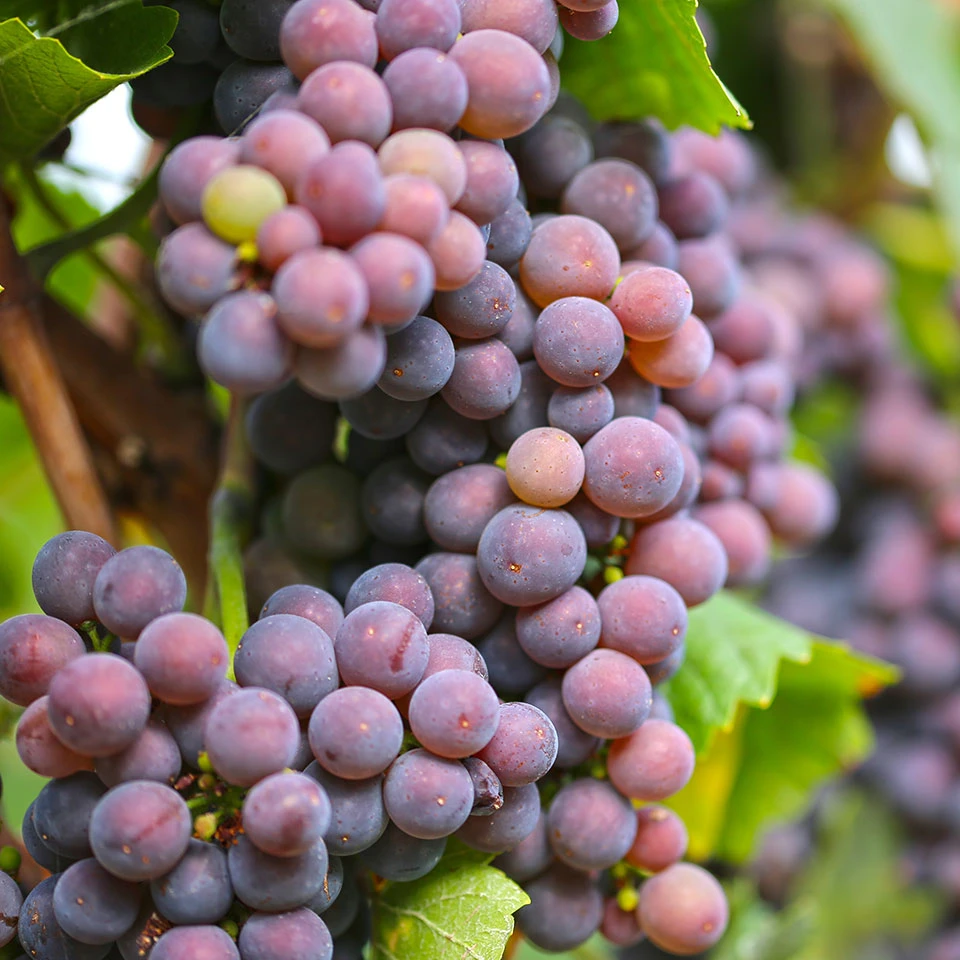
The Blauer Portugieser originally comes from Central Europe, presumably from what is now Slovenia or Austria. Its thin-skinned grapes make it sensitive in the vineyard, but allow it to be harvested early, which protects it from autumnal weather changes. They ensure a rather light, ruby red colour, mild tannins and a pleasantly uncomplicated structure. Typical flavours are red berries such as raspberry and redcurrant, often accompanied by delicate floral nuances or a subtle earthiness. The variety is often used to produce fresh rosé wines (such as Weissherbst) or in light cuvées to give them freshness and drinkability. In recent years, however, targeted yield reduction has led to an increase in high-quality, single-varietal Portugieser wines that fully develop their down-to-earth elegance. In keeping with its rather light character, this variety shows its strengths above all with uncomplicated dishes. A hearty snack, cold platters or light-coloured poultry are its domain.
Frequently asked questions (FAQ) about Portugieser wine

What does a typical red wine made from the Portugieser grape variety taste like?

A wine made from the Portugieser grape variety is usually a light, drinkable wine. It is known for its rather low alcohol content and soft texture. On the palate, it is light-hearted, uncomplicated and very accessible.

What flavours are characteristic of the Portugieser grape variety?

On the nose, Portugieser has a charming bouquet of red berries such as raspberry and strawberry, often complemented by notes of redcurrant and sour cherry. Occasionally there are also subtle floral nuances (such as violets) or a slightly earthy flavour.

Does the Portugieser grape variety actually come from Portugal?

The answer is: No! Even if the name suggests it, the Portugieser grape variety has no connection to Portugal. DNA analyses suggest that the variety originated in the Danube region (probably present-day Slovenia or Austria) and found its way to Germany in the 19th century.

Where is the Portugieser grape variety most successfully cultivated today?

The largest areas of the Portugieser grape variety are found in Germany, particularly in the Palatinate and Rheinhessen. It is also widespread in Austria (especially in the Weinviertel and the Thermenregion) and in Hungary.

Which food pairing goes best with the Portugieser grape variety?

Portugieser is the classic wine for a snack. It harmonises wonderfully with ham, salami and cheese. But it is also an excellent accompaniment to warm, rather light dishes such as roast poultry, pork fillet or savoury stews.

How does the Portugieser grape variety differ from Pinot Noir?

While Pinot Noir is usually more complex, richer in acidity and more delicate, Portugieser is less complicated and softer. Where Pinot Noir often demands attention, Portugieser offers immediate, barrier-free drinking pleasure.

Why is the Portugieser grape variety so often vinified as a rosé?

This is due to its thin skin and rapid colour release. The Portugieser grape variety is ideal for the production of rosé wines, as it produces a beautiful salmon pink colour after just a short time on the skins and its mild acidity produces extremely drinkable, fresh summer wines.

What is the ideal drinking temperature for the Portugieser grape variety?

A red Portugieser should be served at a slightly cooler temperature than a heavy Bordeaux. I recommend a drinking temperature of 14 to 16 degrees Celsius. If it is a Portugieser Rosé (often referred to as Weißherbst), 8 to 10 degrees is perfect.

Discover more grape varieties for red wines.

Carignan

Carignan originally comes from Spain - but today it is mainly at home in the neighbouring south of France, Languedoc-Roussillon. It is characterised by a deep dark colour, strong tannins and high acidity.

Read more

Dornfelder

The Dornfelder grape variety is the most successful new red variety from Germany. Dornfelder is known for its medium body and soft tannins - as well as its deep dark colour. However, it should not be confused with the similar-sounding Dunkelfelder variety.

Read more

Lagrein

Lagrein is the oldest documented grape variety in South Tyrol - first mentioned in 1318. Its name is probably derived from Vallagarina, the southern Adige Valley.

Read more

Mourvèdre/Monastrell

Mourvèdre is a red grape variety that is mainly grown in the south of France and Spain, where it is known as Monastrell. The wines are deep-coloured, medium to full-bodied, with high, often rough tannins when young and moderate to high acidity.

Read more

Regent

Regent is a new red variety from Germany. It was developed in the late 1960s, primarily with the aim of creating a high-yielding and disease-resistant red variety - and it was quite successful.

Read more

Pinot Noir

Pinot Noir, or Pinot Noir, is a red grape variety that is widely grown around the world today and is also the basis for some of the rarest and most exquisite wines in the world. The variety has a very long tradition of excellence, particularly in France (especially in Burgundy) and Germany (in the Ahr and Baden regions).

Read more

Discover more grape varieties for white wines.

Cabernet Sauvignon

Cabernet Sauvignon is one of the best known and most widely grown red grape varieties in the world. Originally from Bordeaux, France, it has found success in many wine-growing regions, such as California, Chile and Australia.

Read more

Gewürztraminer

Hardly any other grape variety polarises as much as Gewürztraminer. Its name alone reveals what it is all about: intensity, spice and an unmistakable spectrum of flavours ranging from lychee, bitter orange and rose petals to marzipan. It is not a subtle wine, nor is it meant to be. Some like it, others reject the cloud of flavours.

Read more

Grüner Veltliner

Grüner Veltliner is a white grape variety grown mainly in Austria and is the country's best-known grape. The wines are light to medium-bodied, with moderate acidity and a characteristic pepper aroma that is often compared to white peppercorns or radishes.

Read more

Muscat/Muskateller

Muscat, also known as Muscat or Moscato, is not so much a single grape variety as a fairly large family of grape varieties that is widespread throughout the world and includes both wine grapes and table grapes.

Read more

Riesling

Riesling is one of the best-known white grape varieties and is cultivated all over the world - first and foremost in Germany, of course. It is more flexible and versatile than almost any other grape.

Read more

Silvaner

Silvaner is a white grape variety that originated in Austria, but is now most widespread in Germany, where it plays an important role alongside Riesling. Other noteworthy stocks can still be found in Alsace in France. The wines are known for their freshness, minerality and sometimes strong, earthy character.

Read more

Here you can find information on other grape varieties.

Yout cart is empty.

Added to shopping cart
Subtotal
Go to shopping cart

Prices incl. VAT plus shipping costs.